
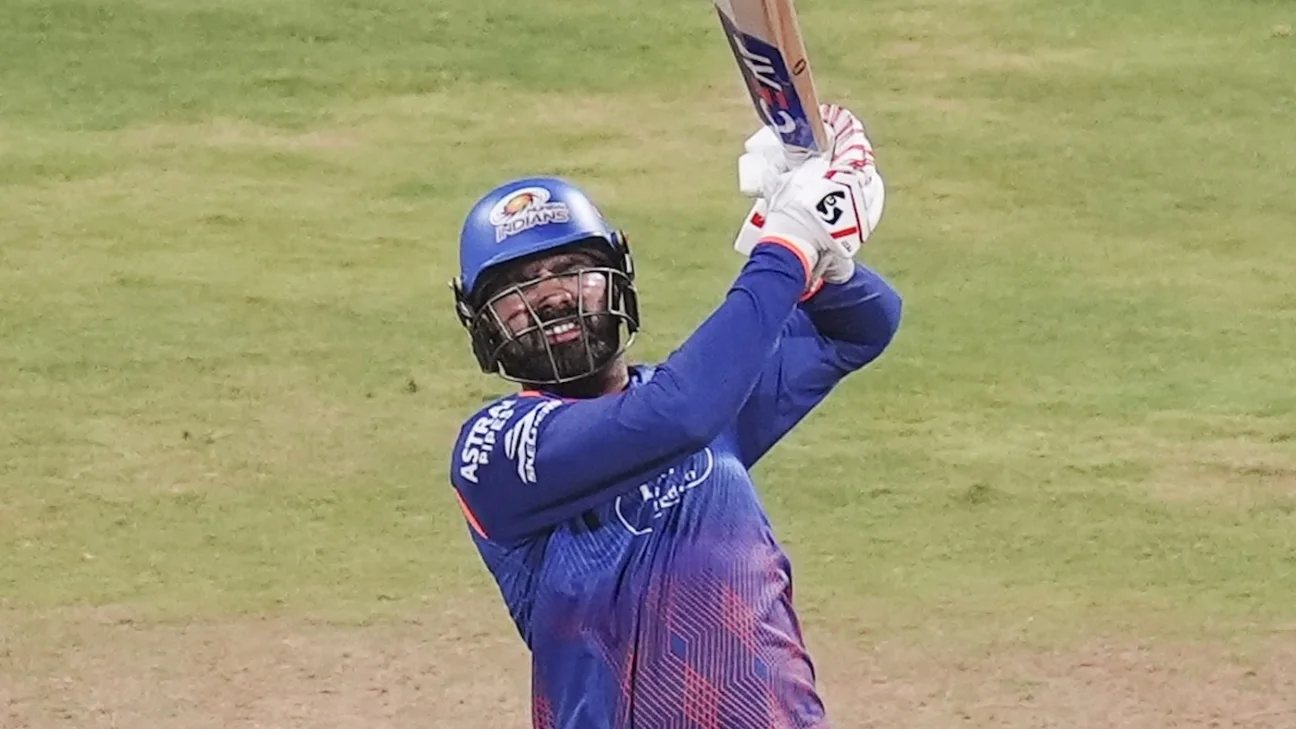
Mumbai Indians arrive in Ahmedabad on Monday facing perhaps their toughest challenge yet in IPL 2026 — not because of Gujarat Titans’ star power, but because of the ruthless consistency that has defined the Gujarat Titans’ squad stability and winning record so far this season. The two sides couldn’t be more different in their approach to building a playing XI, and that divergence could well determine who walks away with the points at the Narendra Modi Stadium.
It’s been a season of contrasts for these two franchises. GT have leaned heavily on a core group of players, rotating just 13 individuals across five matches, and crucially, only because injury to captain Shubman Gill forced their hand in one game. Compare that to MI, who’ve had to shuffle through 17 different players as they’ve battled both injuries and inconsistent form. Only Chennai Super Kings have dug deeper into their squad. The numbers tell you everything about where these two teams stand — GT sit on a three-game winning streak while Mumbai are drowning in a four-game losing run.
There’s usually a strong statistical relationship between squad stability and points-table position, and this season is proving no exception. GT’s ability to keep the same XI on the field has bred familiarity, rhythm, and a collective understanding that’s hard to replicate. But here’s the danger: there could be a price to pay for such steadiness if your best players have an off day simultaneously.
Consider GT’s batting setup. The franchise has constructed their innings around a formidable top three of Shubman Gill, B Sai Sudharsan, and Jos Buttler. These three shoulders carry the bulk of the batting burden, which means that when they fire, GT’s total looks intimidating. Yet this also exposes a vulnerability. Players like Shahrukh Khan, typically used as the Impact Player in chases, has had two did-not-bat appearances and faced only 12 balls across three innings. Washington Sundar, Glenn Phillips, and Rahul Tewatia haven’t contributed substantially with the bat either. It’s a thin margin between competence and catastrophe when you’re this reliant on three individuals.
Mumbai Indians must exploit Gujarat Titans’ batting dependency to turn their campaign around
MI, despite their recent struggles, might actually have identified a pathway forward in this specific matchup. If they can front-load their bowling attack and direct their best attacking options at that dangerous top three, they could disrupt GT’s rhythm before it takes hold. The challenge, though, is significant — MI’s bowling has been plagued by poor economy rates and lacks penetration, with the burden falling almost entirely on Jasprit Bumrah’s shoulders.
Yet there’s a silver lining for the Mumbai franchise. GT bat in what might be described as an old-fashioned, cautious style, leaning heavily on their bowling unit to keep opposition scoring rates in check rather than smashing their way to big totals. This is fundamentally different from the aggressive, high-octane batting that teams like Punjab Kings, Royal Challengers Bengaluru, and Rajasthan Royals have weaponised so effectively over recent seasons. MI have historically struggled against those explosive franchises, but GT doesn’t operate that way. On paper, MI’s batters should find relatively less pressure against GT’s bowlers, provided they can stay disciplined and execute their plans properly.
GT’s bowling, though, cannot be ignored. The franchise has shown remarkable faith in the same four-man fast-bowling unit throughout the tournament — Mohammed Siraj, Kagiso Rabada, Prasidh Krishna, and Ashok Sharma. These four have become the best wicket-taking fast-bowling force of IPL 2026, maintaining a combined bowling average of 24.89, which is the standout statistic in the entire league. Compare that to MI’s fast bowlers, who average a staggering 65.81 — by far the worst in the competition. It’s not even close. Punjab Kings, the next-worst team in this metric, average 37.41.
The individual statistics are even more damning for Mumbai. Trent Boult’s bowling average sits at 110.00, Deepak Chahar at 87.00, and Hardik Pandya at 67.00. Perhaps most concerning is Bumrah, who’s bowled 19 overs without taking a single wicket. When your primary bowling resources are struggling this badly, it becomes nearly impossible to defend totals or contain opposition batting.
Siraj, in particular, deserves a closer look. He hasn’t garnered huge publicity because his wicket tally doesn’t jump out at you, but his new-ball bowling has been genuinely exceptional. Among bowlers who’ve delivered at least 30 balls in the powerplay phase this season, his economy rate of 7.41 is bettered only by Mohammed Shami, Rasikh Salam, and Sunil Narine. On Monday, if he finds his form and delivers another spell of incisive new-ball swing bowling, GT could well see their winning streak extend further.
MI do, however, have some cards to play with selection. Rohit Sharma and Mitchell Santner both missed the Punjab Kings match due to illness, but Mumbai’s bowling coach Paras Mhambrey confirmed on Sunday that both players are fit. Rohit has returned to batting in the nets. His absence against Punjab left MI scrambled — they brought in Quinton de Kock, who responded with a brilliant hundred, but had to sacrifice Trent Boult to keep the overseas contingent at four players. That compromise led to Mayank Rawat’s undistinguished debut at number eight, where he faced a single ball and didn’t even get a chance to bowl.
With Rohit back, Mumbai will likely restore balance, probably bringing in Boult or Corbin Bosch to strengthen the pace bowling. There’s also a tactical question mark hanging over whether Mitchell Santner or AM Ghazanfar will get the nod. Ghazanfar took two crucial powerplay wickets against Punjab, making a case for inclusion.
Sherfane Rutherford is another MI player worth monitoring closely. He’s genuinely one of the world’s best T20 cricketers, yet he’s being miscast as a finisher at Mumbai. Against Punjab, he came in too late against Marco Jansen and Arshdeep Singh, who were executing reverse-swinging yorkers to perfection. In the RCB game, he smashed an unbeaten 31-ball 71, but the match was effectively lost by the time he walked to the crease at number six. MI has now moved Naman Dhir to number four, which creates a logjam where Hardik Pandya, Tilak Varma, and Rutherford all prefer batting positions that allow them to build their innings rather than immediately go into explosive mode. Can MI solve this puzzle against his former franchise? That could be the key to unlocking their season.
GT have shown remarkable consistency in team selection, keeping the same XII whenever possible. With three wins in a row, they’re unlikely to tinker with their combination. Captain Shubman Gill will lead an XI featuring Sai Sudharsan, Jos Buttler (wicketkeeper), Washington Sundar, Glenn Phillips, Rahul Tewatia, Shahrukh Khan, Rashid Khan, Ashok Sharma, Kagiso Rabada, Mohammed Siraj, and Prasidh Krishna. It’s a well-balanced attack and a batting order that, while heavily dependent on its top three, has proven effective in their winning games.
Pitch No. 5 at the Narendra Modi Stadium has historically favoured teams batting first over the last seven matches played there. Across those matches — three each in IPL 2024 and 2025, plus two from the T20 World Cup — the team batting first has won outright four times, drawn once, and lost twice. The first-innings run rate has been noticeably higher at 9.62 compared to the second-innings rate of 9.14. However, Ahmedabad is expecting extreme heat on Monday, with temperatures forecast to reach 40 degrees Celsius, which could lead to dew favoring the chasing team later in the evening.
Assistant coach Parthiv Patel of Gujarat Titans has defended his middle-order batters’ lack of runs, pointing out that when your top three are constantly occupying the crease, the lower order inevitably gets fewer deliveries to face. Last season, Tewatia hit a six off a reversing Mitchell Starc delivery against Delhi, and more recently, Shahrukh Khan finished games despite limited opportunities. The role, Patel insists, is completely different for these players, and runs alone don’t tell the full story of their contribution.
As the two teams prepare for this crucial encounter, the narrative is clear: GT’s squad stability and bowling excellence will be tested against a desperate MI outfit searching for answers. For Mumbai, this might paradoxically be the ideal opponent to build momentum against. Whether they can capitalise on that opportunity, however, remains the pressing question.