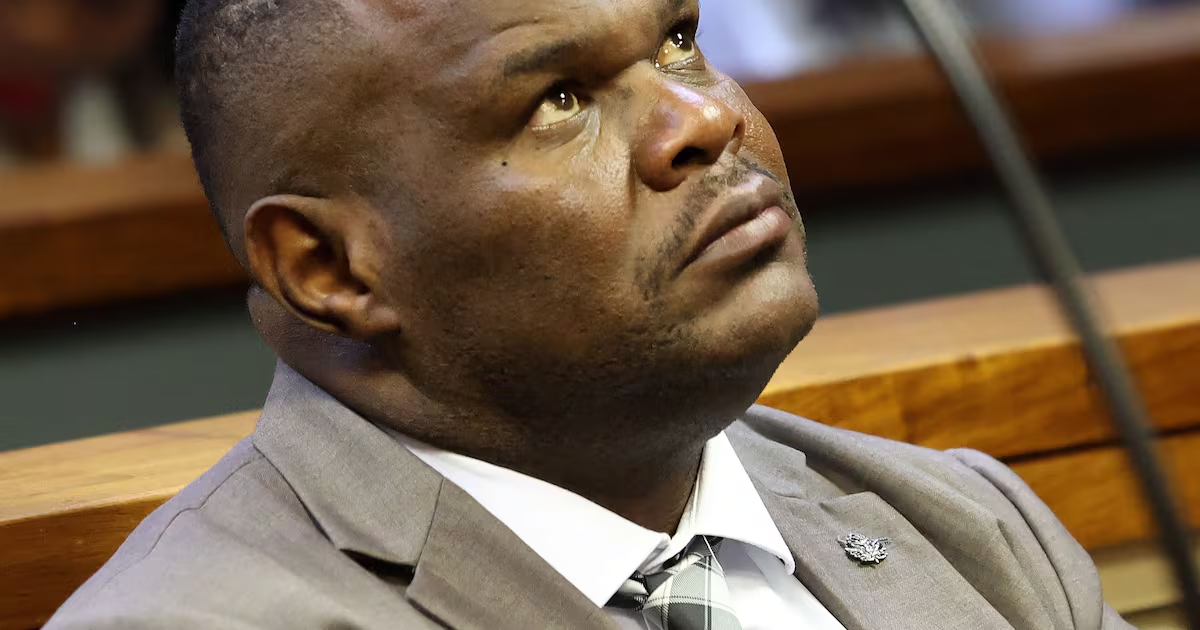
A police sergeant earning just over R16,500 a month has somehow managed to accumulate a luxury motorcycle collection worth well over R1 million — raising serious questions about how public officials are acquiring high-end assets on modest government salaries. Sergeant Fannie Nkosi, a member of the organised crime unit, has become the latest focus of scrutiny following revelations about his fleet of expensive bikes, drawing uncomfortable parallels to suspended Tshwane CFO Gareth Mnisi, who himself sports a collection of vehicles valued at several million rand.
The apparent wealth disparity is staggering. According to vehicle ownership records, Nkosi owns a touring Harley-Davidson valued at approximately R820,000, a Harley-Davidson VRSCA worth around R100,000, a Suzuki M109R valued at over R250,000, and a Regal Raptor 350cc estimated at R25,000. He also owns a Land Rover and two quad-bike trailers. For a sergeant drawing a salary of roughly R16,500 monthly, the mathematics simply don’t add up — a reality that forms part of the troubling allegations now engulfing the Madlanga commission of inquiry.
Nkosi’s legal troubles compound the luxury lifestyle questions. He was arrested earlier this month after police discovered state-owned ammunition, a hand grenade, R50,000 in cash, and seven unsecured licensed firearms at his residence. He faces a bail application that continues at the Pretoria magistrate’s court, where the extent of alleged misconduct — including claims of acting as a middleman between crime bosses and senior officers — is being scrutinised. His arrest came shortly after he testified at the commission, where he made sensational allegations about a “double life.”
How police officers and government officials are allegedly building questionable wealth
The connection between Nkosi and Mnisi offers a window into how state resources may be diverted and how personal relationships can blur into corrupt arrangements. Mnisi confirmed during his commission testimony that he met Nkosi through an acquaintance, and the suspended CFO acknowledged that their friendship deepened during his personal difficulties. In his statement, Mnisi said: “I found Sgt Nkosi to be a good listener, and I found myself confiding in him increasingly, seeking his guidance and advice and relying on him for support in respect of the personal challenges I was facing.”
Yet beneath this ostensibly innocent friendship lay something far more sinister. Evidence presented to the commission, including WhatsApp messages, allegedly shows Nkosi sending Mnisi the names of companies bidding for security contracts with the Tshwane metro police department. The implication was clear — Nkosi wanted Mnisi to ensure particular companies, including Ngaphesheya Construction and Projects, which Nkosi claimed was owned by his brother, would win the tenders.
Mnisi’s explanation to the commission’s chief evidence leader, Matthew Chaskalson, was unconvincing. He claimed he thought Nkosi merely wanted him to check bid compliance, and that he regularly assisted suppliers with procurement challenges. However, the facts tell a different story. Ngaphesheya has received over R2 million despite allegations it was non-compliant when awarded the tender. As chair of the bid adjudication committee, Mnisi held significant oversight authority — a position that apparently granted him and his associates considerable influence.
The CFO’s own accumulation of wealth is equally striking. Mnisi earns a net salary of R124,000 monthly, yet somehow owns a fleet that includes a Porsche Targa worth R6 million, a BMW X6 M50d valued at R1.9 million, two BMW 125i models, a Mercedes-Benz CLA 45, and a VW Golf 8 R. He allegedly also possesses at least three Tag Heuer watches, each valued around R34,000. Like Nkosi’s motorcycle collection, Mnisi’s vehicles and accessories suggest financial resources far exceeding what his government salary could support.
Mnisi’s suspension came this week pending the outcome of internal city investigations into allegations of tender manipulation. He has been accused of assisting preferred companies to secure multimillion-rand contracts irregularly — the very allegations that emerged when Nkosi’s relationship with him was exposed. The timing of events suggests a coordinated network of officials and contractors working to divert public resources, with personal relationships and emotional vulnerabilities serving as cover for fundamentally corrupt arrangements.
The troubling pattern evident in both men’s cases reflects broader concerns about governance and accountability within state institutions. When sergeants and CFOs can accumulate luxury assets incompatible with their declared incomes, and when those accumulations coincide with tender irregularities and procurement violations, it suggests systematic failures in oversight and consequence. The Madlanga commission’s work continues to uncover layers of this apparent misconduct, but the cases of Nkosi and Mnisi demonstrate how personal trust, emotional manipulation, and proximity to procurement processes can be weaponised to facilitate corruption at scale. As we await further developments in both the bail application and the internal investigations, these revelations serve as a stark reminder of the cost of unchecked state capture — borne ultimately by taxpayers across Gauteng and the nation.