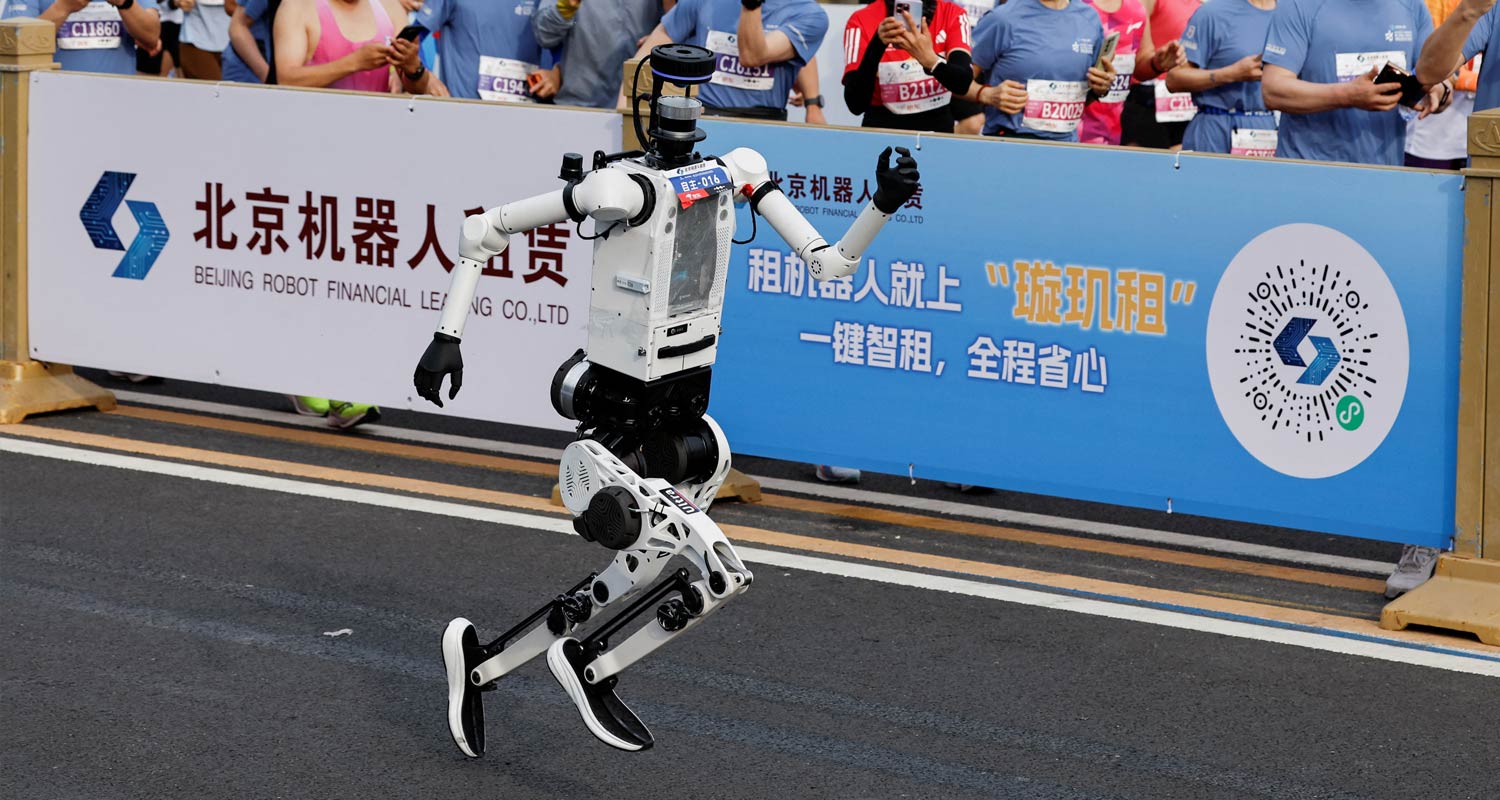
In a stunning display of technological prowess that’s captured global attention, humanoid robots have now outpaced world-class human athletes, with Chinese-made machines sprinting through Beijing’s streets faster than professional runners at a groundbreaking half-marathon event. What unfolded on the streets of China’s capital this past weekend represents a watershed moment in robotics development—one that underscores how rapidly autonomous machines are closing the gap with human physical performance.
The second Beijing E-Town Half Marathon featured an extraordinary spectacle: over 100 robot teams competing alongside 12,000 human runners, with several mechanical competitors finishing the 21-kilometre course in times that shattered professional records. This stark contrast to last year’s inaugural event, where most robots failed to finish and the winning unit clocked a sluggish 2 hours and 40 minutes, reveals just how exponentially the field has advanced in twelve months.
Honor, the Huawei spin-off smartphone manufacturer, absolutely dominated proceedings. The company’s winning humanoid robot crossed the finish line in 50 minutes and 26 seconds—several minutes faster than Ugandan runner Jacob Kiplimo’s half-marathon world record of 58 minutes and 41 seconds, set in Lisbon just weeks earlier. It’s a remarkable achievement that has sent ripples through the global tech and sports communities alike.
What makes this year’s performance even more impressive is the level of autonomy on display. Unlike 2025, when most robots required remote control guidance, nearly half of this year’s entrants navigated the challenging course completely autonomously, relying on their own artificial intelligence to manage obstacles, terrain variations, and race dynamics without human intervention.
How humanoid robots are redefining athletic performance and industrial capability
Du Xiaodi, an engineer from Honor’s winning team, revealed that the champion robot was specifically designed to mirror elite human runners, complete with legs measuring 90-95 centimetres to replicate natural athletic motion. The machine also incorporates liquid cooling technology borrowed from Honor’s smartphone engineering—a detail that speaks to how innovations cascade between industries. Du emphasised that whilst the racing application might seem superficial, it serves as a crucial testbed for technologies with serious industrial applications.
“Running faster may not seem meaningful at first, but it enables technology transfer, for example, into structural reliability and cooling, and eventually industrial applications,” Du explained to observers at the event. The broader implication here is that humanoid robots aren’t simply being developed as curiosities or novelties—they’re being engineered as practical solutions for industries ranging from manufacturing to hazardous environments.
The spectacle wasn’t lost on younger generations either. Chu Tianqi, a 23-year-old engineering student from Beijing University of Posts and Telecommunications, expressed awe at what he witnessed. “The humanoid robots’ running posture I saw was really quite impressive,” he said. “Considering that AI has only been developing for a short time, I’m already very impressed that it can achieve this level of performance.” More tellingly, he warned that those who resist adopting AI would “definitely become obsolete” in the coming decades.
An 11-year-old spectator, Guo Yukun, left the event so inspired that he’s now seriously considering a university degree in robotics. Already enrolled in robotics theory and programming classes at his elite Beijing school and competing in international programming competitions, he represents the generation that will likely see humanoid robots become commonplace in workplaces and homes.
Yet experts urge caution against reading too much into the racing accomplishment. Whilst the speed and autonomy on display are genuinely impressive, these capabilities don’t automatically translate to real-world industrial deployment. The critical gap remains in artificial intelligence software—Chinese robotics firms are still struggling to develop the sophisticated AI needed for humanoids to match the dexterity, adaptability, and efficiency of human factory workers in complex manufacturing environments.
The racing competition showcased what these machines can do when optimised for a single, relatively straightforward task: running in a straight line over a known distance. Industrial applications demand far more: fine motor control, real-time problem-solving, the ability to handle unexpected situations, and the capacity to learn and adapt to new scenarios. These remain significant challenges.
Nevertheless, China is making a deliberate, strategic push to become the global leader in humanoid robotics. The government has implemented subsidies, infrastructure projects, and policy frameworks designed to cultivate and accelerate domestic firms. This ambition was made crystal clear during February’s CCTV Spring Festival gala—the nation’s most-watched annual television programme—which featured an extended martial arts demonstration where over a dozen Unitree humanoids performed sophisticated choreographed fight sequences, wielding swords, poles, and nunchucks alongside child performers.
These aren’t accidental displays. They’re carefully calibrated messaging about China’s technological trajectory and its determination to dominate what many consider the next frontier of industrial capability. Whether humanoid robots will truly revolutionise manufacturing, healthcare, defence, and other sectors remains to be seen, but what happened in Beijing this weekend proved one thing conclusively: we’re no longer watching robots struggle to complete basic tasks—we’re watching them outrun Olympic-calibre athletes.