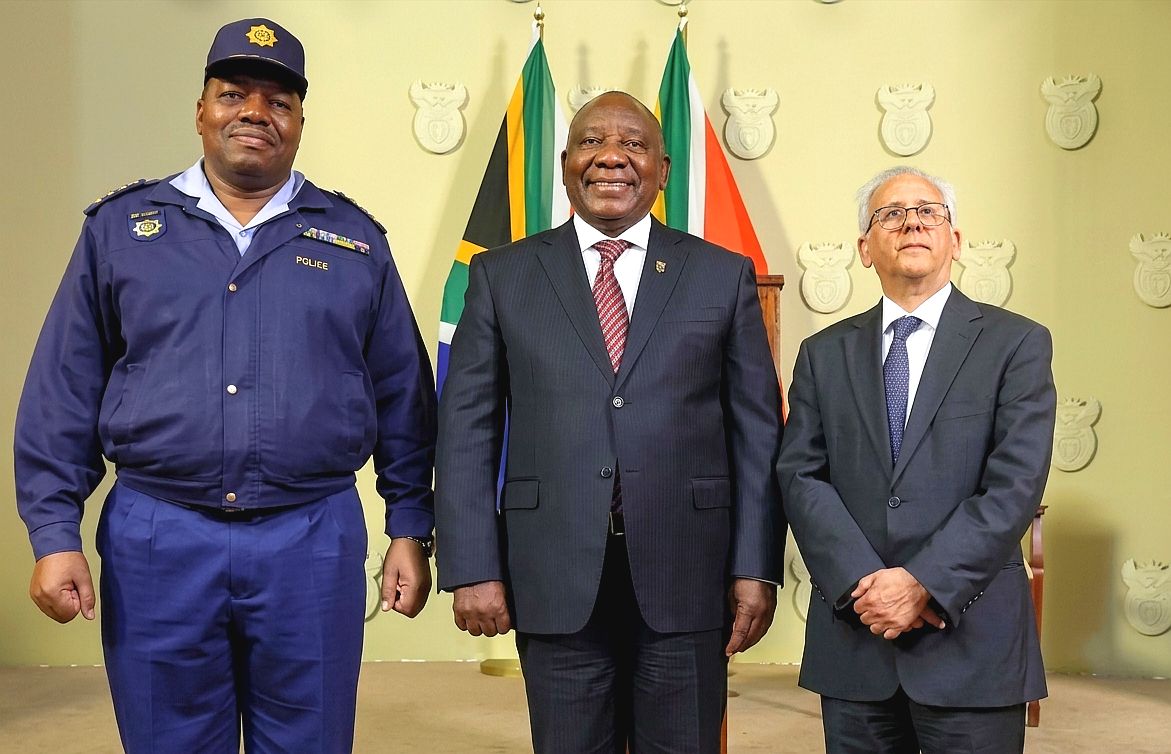
President Cyril Ramaphosa is preparing to make a significant announcement regarding the leadership of the South African Police Service, with sources close to the Union Buildings confirming that National Police Commissioner General Fannie Masemola is expected to face suspension following a week of mounting pressure on the law enforcement agency’s top echelon. The president, accompanied by Acting Minister of Police Firoz Cachalia, scheduled a media address for 4PM today at the Union Buildings, signalling that a major shake-up in policing leadership is imminent.
The development comes after Masemola was formally charged earlier this week with alleged contraventions of the Public Management Finance Act (PMFA), marking an unprecedented move against the country’s highest-ranking police officer. The charges have sent shockwaves through Pretoria’s corridors of power, with questions swirling about what comes next for the embattled commissioner and who might step into his shoes during what promises to be a turbulent transitional period.
Our reporting on this matter reflects the gravity of the situation facing South Africa’s policing establishment at a time when public confidence in law enforcement remains fragile. The suspension of a sitting national commissioner would represent a watershed moment in the institution’s modern history, underlining the seriousness with which the presidency is treating the allegations levelled against Masemola’s tenure. Multiple sources have indicated to us that an acting National Commissioner is also set to be named during today’s address, suggesting the government wants to ensure continuity at the helm of the SAPS even as it deals with the controversy.
Leadership vacuum looms as Masemola suspension signals seismic shift in police command structure
The timing of this announcement raises critical questions about the state of governance within our national police force and whether the challenges facing the SAPS run deeper than one individual’s alleged administrative missteps. Masemola, who assumed the commissioner’s role in 2022, has presided over a period marked by both operational successes and significant setbacks, including ongoing struggles with corruption, capacity constraints, and public safety concerns that have dogged the service for years.
What makes this moment particularly significant is that it demonstrates the executive’s willingness to act decisively when senior state officials face serious allegations. The president’s personal involvement in making this announcement underscores the political weight attached to the decision and suggests that the matters at hand extend beyond routine administrative procedures. This isn’t simply about a personnel shuffle—it reflects systemic tensions within law enforcement governance that have been brewing for some time.
The specifics of Masemola’s alleged PMFA contraventions haven’t been fully detailed in the public domain, but financial governance failures at the level of the National Commissioner would constitute a serious breach of trust and public accountability. Such allegations, if substantiated, would strike at the heart of institutional integrity and raise uncomfortable questions about oversight mechanisms within the broader state apparatus.
For communities across South Africa already struggling with service delivery challenges and police accountability issues, this development may be viewed through different lenses. Some will see it as necessary accountability, whilst others may worry about the operational implications of leadership instability at the SAPS during a period when crime remains a pressing national concern. The appointment of an acting commissioner will need to signal both continuity and a commitment to reform.
What remains unclear is the extent to which this disciplinary action reflects broader governance concerns within law enforcement or constitutes an isolated incident. Either way, today’s announcement from the Union Buildings will mark a turning point in the current chapter of South African policing, and the nation will be watching closely to see how the transition unfolds and what it ultimately means for the future direction of the SAPS.