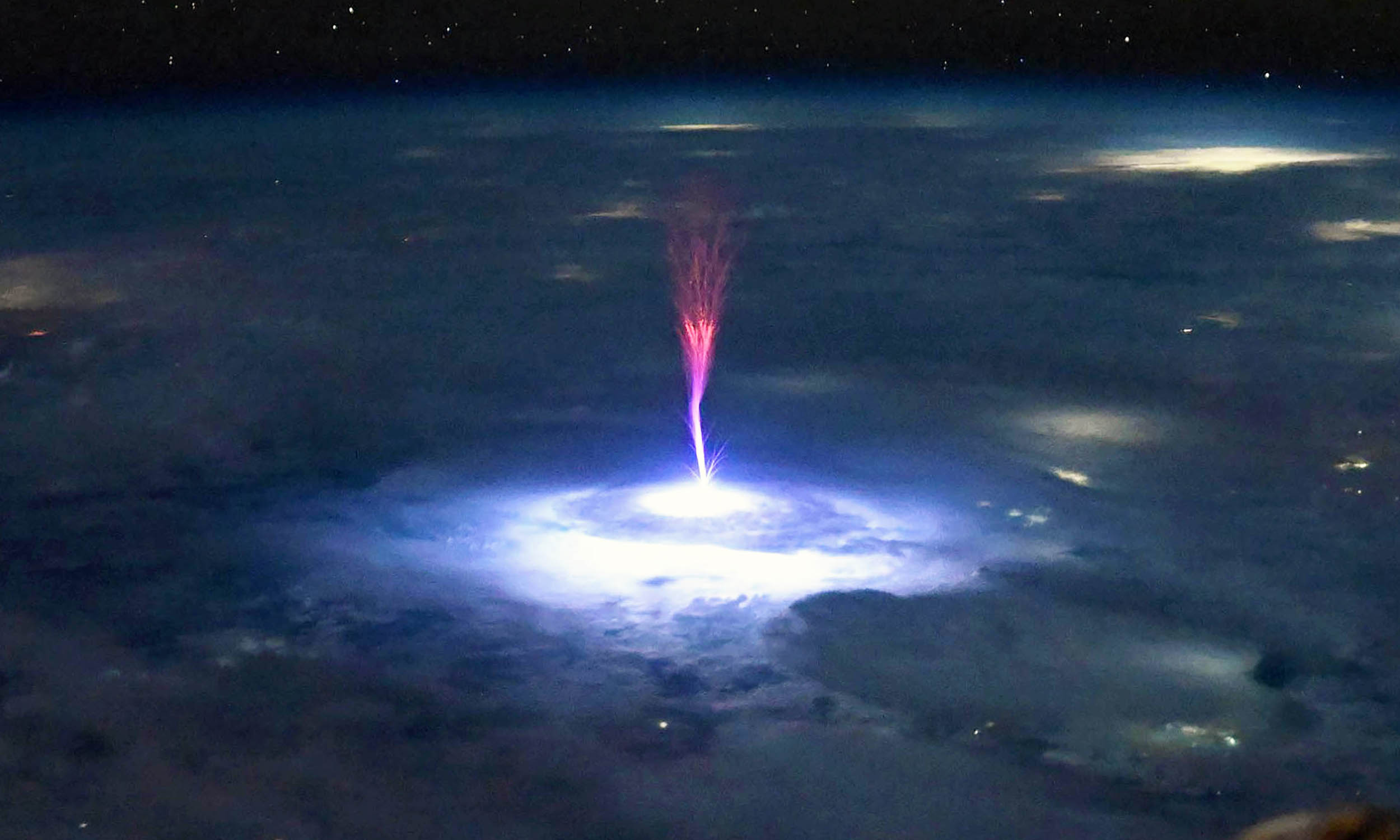
Thunderstorms that roll across the Highveld or tumble over the Karoo do more than light up the sky. While most of us hear the distant rumble of thunder and see a flash of lightning, a whole theatre of electric fireworks erupts up to 55 miles above the clouds, invisible to the naked eye. These fleeting bursts – blue jets, red sprites, violet halos and ultraviolet rings – belong to the family of transient luminous events (TLEs), a phenomenon that has only recently left the realm of pilot folklore and entered scientific laboratories aboard the International Space Station (ISS).
From our Johannesburg newsroom we have been following the work of researchers who, for the first time, can watch these high‑altitude discharges from an unobstructed perch above the atmosphere. The data they gather is reshaping everything from radio‑communication forecasts to aviation safety, and even the chemistry of the upper atmosphere that influences climate models.
Transient luminous events: the ISS‑based laboratory lighting up the night sky
The star of the operation is the Atmosphere‑Space Interactions Monitor (ASIM), a European Space Agency instrument that has been attached to the exterior of the ISS since 2018. ASIM’s ultra‑fast cameras and photometers are capable of spotting flashes smaller than a fingernail and shorter than a heartbeat, capturing details that ground‑based sensors simply miss.
Early results have been astounding. Researchers discovered that certain lightning‑like eruptions at the crest of a thundercloud can inject a burst of electromagnetic energy into the ionosphere, spawning a gigantic ELVES (Emission of Light and Very low‑frequency perturbations due to Electromagnetic pulse Sources)‑type ring of ultraviolet light. These rings can charge the ionosphere for hundreds of kilometres, potentially scrambling long‑range radio signals that pilots and maritime operators rely on.
ASIM has also logged a series of ultra‑brief corona discharges – bursts so brief they vanish before most instruments can react. By timing these events, scientists are piecing together how the upper layers of a storm prime the atmosphere for full‑blown lightning, a puzzle that has lingered for decades.
The significance for South Africa is clear. Our national power grid, already strained by load‑shedding, could see unexpected interference during intense TLE activity over the Cape coast, while airlines that fly the Cape Town–Johannesburg corridor may need to factor in new electrical‑field risk zones when charting polar routes.
Strange “red sprites” phenomenon
Red sprites, the upside‑down jelly‑fish‑like flashes that blink for just ten milliseconds in the mesosphere, and blue jets, the silent, upward‑shooting bolts that pierce the stratosphere, were once thought to be exotic curiosities. Thanks to ASIM, we now have precise altitude measurements confirming that blue jets can surge beyond the traditional weather layer, reaching heights of 50–60 km.
These measurements feed directly into storm‑charging models that underpin aviation guidelines across the globe, including South African Airways’ routes that skirt the southern Indian Ocean. Understanding where dangerous electric fields may lurk can help pilots avoid sudden turbulence or equipment failures caused by high‑altitude discharges.
ISS crew captures red sprites from orbit
The ISS cupola – the iconic seven‑window dome that has featured in countless astronaut selfies – doubles as a scientific observatory. Through the European Space Agency’s Thor‑Davis experiment, crew members have mounted a high‑speed camera behind the cupola glass, recording storms at up to 100 000 frames per second. The resulting slow‑motion footage reveals electric filaments branching in patterns that textbooks never predicted.
For us at SA Report, the practical upside is compelling: the ultra‑detailed movies can improve algorithms that warn South African power‑grid operators when severe lightning threatens transmission lines, potentially giving utilities precious minutes to isolate vulnerable sections before a blackout spreads.
Catching invisible lightning pulses
Not all storm‑driven energy is visible. Some lightning strikes unleash terrestrial gamma‑ray flashes (TGFs) – bursts of high‑energy radiation comparable to a chest X‑ray that can momentarily bathe an aircraft in ionising particles. To map these hidden hazards, the Japanese space agency JAXA, together with university partners, released the Light‑1 CubeSat from the ISS. Roughly the size of a loaf of bread, Light‑1 carries detectors tuned to capture gamma photons over equatorial storm systems.
When Light‑1’s timestamps are matched with ground‑based lightning networks, scientists can build a three‑dimensional atlas of TGF hotspots. This knowledge is particularly relevant for South Africa’s growing fleet of low‑orbit satellites, which operate in the same radiation‑rich environment.
Storms mess with signals
At first glance, a red sprite or ELVES ring may look like an exotic cousin of the aurora, but the layers they illuminate are the very same that ferry radio waves, submarine communications and GPS signals. Disturbances in these charged layers can cause sudden signal fading, a problem that could affect South Africa’s submarine cable links to Europe and Asia.
For airlines, especially those traversing polar routes, knowing when and where blue jets or TGFs appear adds a crucial safety layer. Meanwhile, climate scientists are probing how TLE‑induced corona discharges shuffle nitrogen oxides and other chemicals between atmospheric strata, subtly tweaking ozone chemistry and the Earth’s radiative balance. Incorporating this vertical mixing into climate models may tighten predictions of future warming – an issue that resonates deeply with South Africa’s commitments under the Paris Agreement.
Lightning trackers get upgrades
The ISS is expected to stay operational well into the next decade, meaning ASIM and its successors will continue amassing a library of once‑invisible storm events. Engineers are already sketching next‑generation detectors that trigger automatically, record even faster, and span a broader spectrum from radio waves to hard X‑rays. A fleet of Light‑1‑type CubeSats could soon deliver real‑time alerts to weather agencies and satellite operators whenever a TLE erupts above any continent, including our own.
Above all, the space station demonstrates a simple truth: to fully understand Earth’s weather, we sometimes need to look down from above. Each orbit adds new frames to lightning’s hidden movie reel, bringing us closer to predicting – and perhaps mitigating – the electrical surprises that storms fling toward the edge of space.
As we continue to watch the skies from both ground and orbit, SA Report will keep you informed about how these spectacular, fleeting flashes impact everything from our power‑grid resilience to aviation safety, proving that even the most ethereal phenomena have concrete consequences for South Africans.