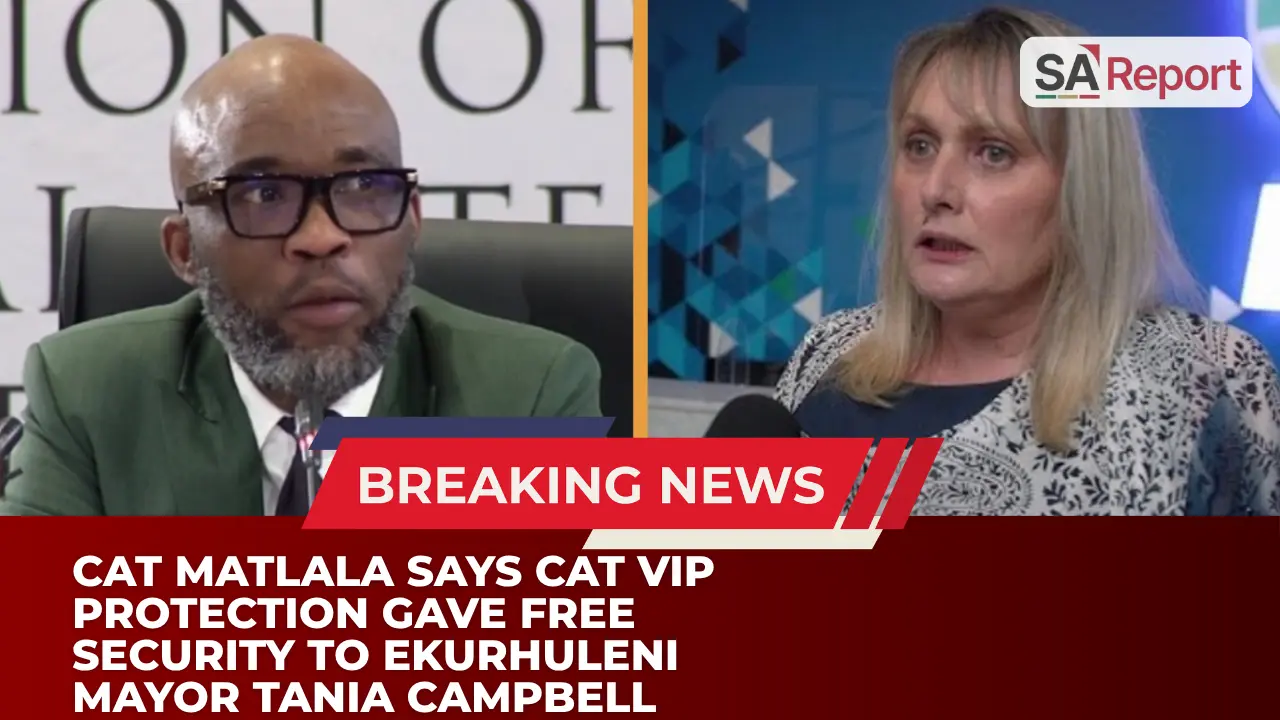
Vusimuzi “Cat” Matlala has gone on the front foot at the Madlanga Commission, insisting that his company CAT VIP Protection never received a single rand from the Ekurhuleni Metropolitan Police Department (EMPD) — and that the only arrangement his businesses had with the municipality was providing free security services to former Ekurhuleni mayor Tania Campbell.
Matlala, who appeared before the commission this week, was categorical in his denial. “I place on record that none of my companies were ever awarded contracts by EMPD and that the only business that was concluded was for no financial gain,” he said. It is a significant claim, given the cloud of scrutiny that has hung over the relationship between his security outfit and senior Ekurhuleni officials.
The testimony is notable because earlier evidence placed before the commission pointed to memoranda of understanding between CAT VIP Protection and EMPD officials. Those arrangements reportedly involved the use of private security vehicles fitted with blue lights and their deployment in municipal security operations — details that raised serious questions about whether public resources and authority were being blurred with private interests.
Matlala’s version, however, is that none of that translated into financial benefit for his companies. His position is that CAT VIP’s footprint inside Ekurhuleni’s security structures was limited to the personal protection of Campbell, offered at no charge to either the mayor or the municipality.
Cat Matlala and CAT VIP Protection’s Ties to Ekurhuleni Face Scrutiny at Madlanga Commission
The distinction Matlala is drawing matters enormously in the context of this inquiry. There is a meaningful legal and ethical difference between a private security company providing complimentary services to a public official and that same company securing paid contracts through a metro police department. The former, while still raising questions about motive and influence, does not on its face constitute procurement corruption. The latter would be a far more serious matter.
What the commission will need to establish is whether the memoranda of understanding — which have already been entered into evidence — reflect a relationship that was truly non-commercial, or whether value flowed in ways that did not appear in formal payment records. Blue-light-fitted vehicles operating alongside or within an official metro police environment represent a form of access and authority that carries its own worth, even without an invoice attached.
Tania Campbell, who served as Ekurhuleni’s executive mayor before being removed following a motion of no confidence in 2023, has been a central figure in several governance controversies linked to the metro. Her name appearing in testimony about private security arrangements will do little to quiet ongoing questions about how the city was administered during her tenure.
Matlala’s testimony before the Madlanga Commission is not yet complete. Further questioning is expected, with commissioners likely to press him on the specifics of how the CAT VIP and EMPD relationship was structured, who authorised the arrangements, and what oversight — if any — existed over the use of his company’s personnel and vehicles in what were ostensibly public law enforcement environments.
The Madlanga Commission was established to investigate governance failures and alleged misconduct within Ekurhuleni, and the evidence being led has repeatedly touched on the intersection of private business interests and public office. As we continue to follow proceedings, the picture emerging is one of a metro where the lines between official structures and private operators became uncomfortably blurred.
Whether Matlala’s account holds under further cross-examination remains to be seen. The commission’s work is ongoing, and the testimony of a man at the centre of one of its more closely watched storylines is far from concluded.