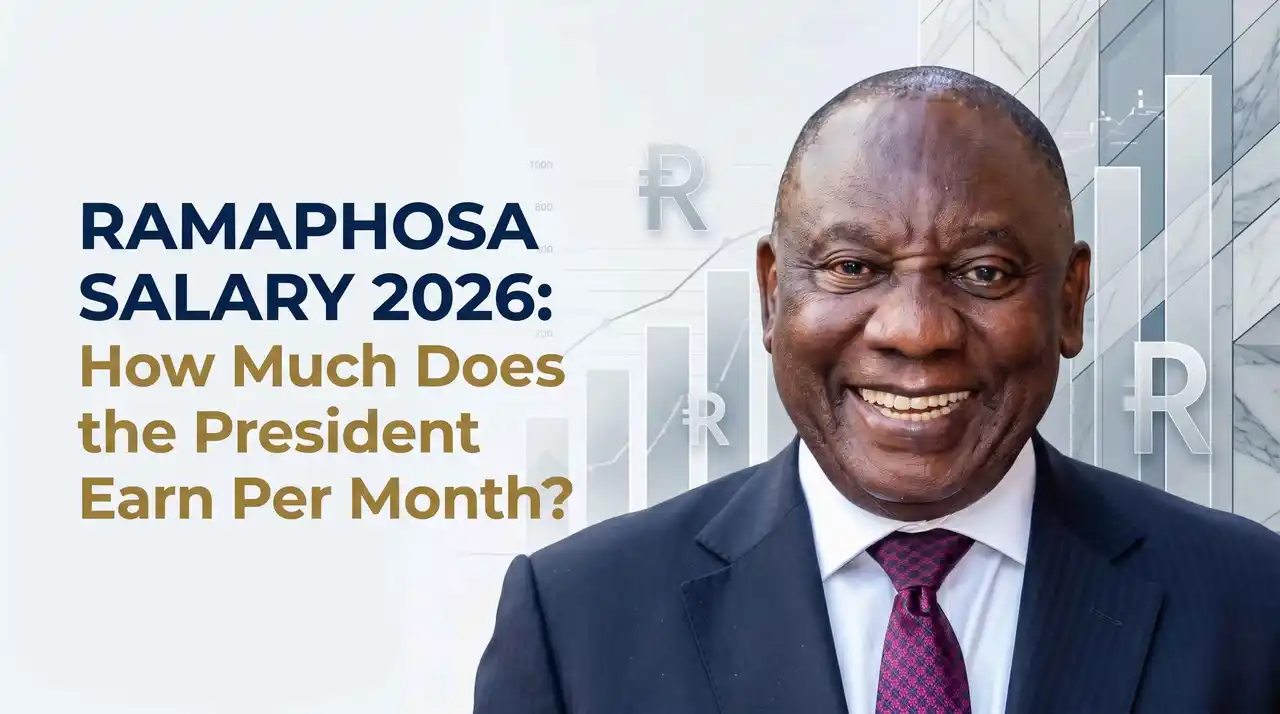
President Cyril Ramaphosa earns an annual salary of R3,484,911, which works out to approximately R285,450 per month. This follows a 3.8% increase approved by the National Assembly on 3 March 2026, raising his package up from roughly R3.35 million the previous year.
But the headline figure only tells part of the story. To understand what the President of South Africa actually costs taxpayers — and how that compares to ordinary citizens, other leaders, and the country’s economic reality — the details matter.
Ramaphosa’s Salary in 2026: The Exact Numbers
The President’s remuneration is set annually within a strict legal framework. Here is how it has moved over recent years:
| Financial Year | Annual Salary | Adjustment |
|---|---|---|
| 2025/2026 | R3,484,911 | +3.8% increase |
| 2024/2025 | ~R3,348,000–R3,350,000 | +2.5% across-the-board hike |
| 2023/2024 | ~R3,079,540 | Inflation-linked adjustment |
The 2026 figure equates to roughly R285,450 per month before tax. In US dollar terms, this places Ramaphosa’s earnings at approximately $223,500 annually.
How the President’s Salary Compares
Within South Africa
Ramaphosa sits at the top of the public office pay structure:
- Cabinet Ministers: ~R2,690,000 per year
- Deputy Ministers: ~R2,215,000 per year
- Lowest-level MP: ~R1,275,000 per year
Against the average South African, the gap is stark. The average formal-sector salary is roughly R26,500 to R29,500 per month, while the median wage sits much lower at R15,000 to R17,000 per month. The National Minimum Wage stands at R30.23 per hour.
Globally
Compared to other world leaders, Ramaphosa’s salary is modest:
- US President Donald Trump: ~R547,500 per month (R6,569,996 annually)
- UK Members of Parliament: ~R3,440,075 annually
Across Africa
Among African heads of state, Ramaphosa ranks among the higher earners, but not at the very top:
- Paul Biya (Cameroon): ~ $620,000–670,000
- King Mohammed VI (Morocco): ~$480,000
- Cyril Ramaphosa (South Africa): ~$223,500
- William Ruto (Kenya): ~$192,000
- Paul Kagame (Rwanda): ~$85,000
- Bola Ahmed Tinubu (Nigeria): ~$69,000
How the President’s Salary Is Actually Decided
Contrary to common belief, the President cannot simply set his own pay. The process is governed by Section 219 of the Constitution and the Remuneration of Public Office Bearers Act, and follows a clear chain:
- The Independent Commission for the Remuneration of Public Office Bearers reviews salaries, considers inflation and fiscal conditions, and produces recommendations.
- The President considers those recommendations and issues a formal determination — but cannot operate outside the statutory framework.
- Parliament scrutinises the determination through the National Assembly and its committees.
- The Government Gazette publishes the final figures, giving them legal effect.
The commission’s recommendations are advisory, not binding. In practice, government may implement the increase in full, partially, defer it, or freeze salaries entirely during periods of economic pressure.
Notably, a President may decline an increase or donate part of the salary, since the money becomes personal income once paid. The legal remuneration remains unchanged regardless of what the office-holder chooses to do with it.
Beyond the Salary: The Real Cost of the Presidency
The President’s monthly pay is only one component of the cost of the office. State-funded benefits include:
- Official residences: Mahlamba Ndlopfu in Pretoria and Genadendal in Cape Town, with the state covering maintenance, utilities, security upgrades, groundskeeping, and domestic staff.
- Travel: Dedicated VIP and charter aircraft, helicopters, motorcades, and diplomatic travel support.
- Security: One of the highest levels of protection in the country, coordinated through the South African Police Service.
- Staff: Advisers, legal experts, communications teams, protocol officers, and administrative support funded through the Presidency’s budget.
- Medical benefits: State contributions toward the President’s medical aid.
These benefits are largely operational necessities rather than luxuries — but the lack of a transparent “cost per presidency” figure keeps them a recurring point of public debate.
After Leaving Office
Former presidents continue to receive a parliamentary-determined pension, ongoing medical aid contributions, state-funded security based on threat assessments, and office and staff support. These benefits can extend for decades, which is precisely why post-retirement provisions tend to attract the sharpest public scrutiny.
A History of Pay Restraint and Controversy
Presidential pay in South Africa has repeatedly become a political flashpoint:
- COVID-19 (2020): Ramaphosa and his Cabinet voluntarily took a 33% salary cut for three months, donating the funds to the COVID-19 Solidarity Fund.
- 2020/2021 freeze: The Independent Commission recommended a 0% increase for public office bearers amid pandemic-driven fiscal pressure.
- 2016 freeze: Under President Jacob Zuma, a salary freeze for top office bearers was framed as a “patriotic sacrifice.”
- Nkandla: State-funded upgrades to Zuma’s private residence shifted public debate from what the President earns to what the Presidency actually costs — culminating in a Constitutional Court ruling that he repay a portion.
- The Zondo Commission: While not focused on salaries directly, it reshaped public perception by exposing how the “visible salary” is dwarfed by the hidden cost of governance failure.
The Bigger Picture
The President’s salary and benefits are not out of step with global norms for heads of state. In fact, by international standards, R3.48 million a year is comparatively modest.
But in a country marked by extreme inequality, high unemployment, and persistent fiscal strain, even a moderate, inflation-linked 3.8% increase becomes politically loaded. The President’s pay is fiscally small but politically loud — a small line item that triggers outsized debate every adjustment cycle.
The real issue, then, is rarely the salary itself. It is the widening gap between the country’s leadership and the economic reality of the citizens it governs.